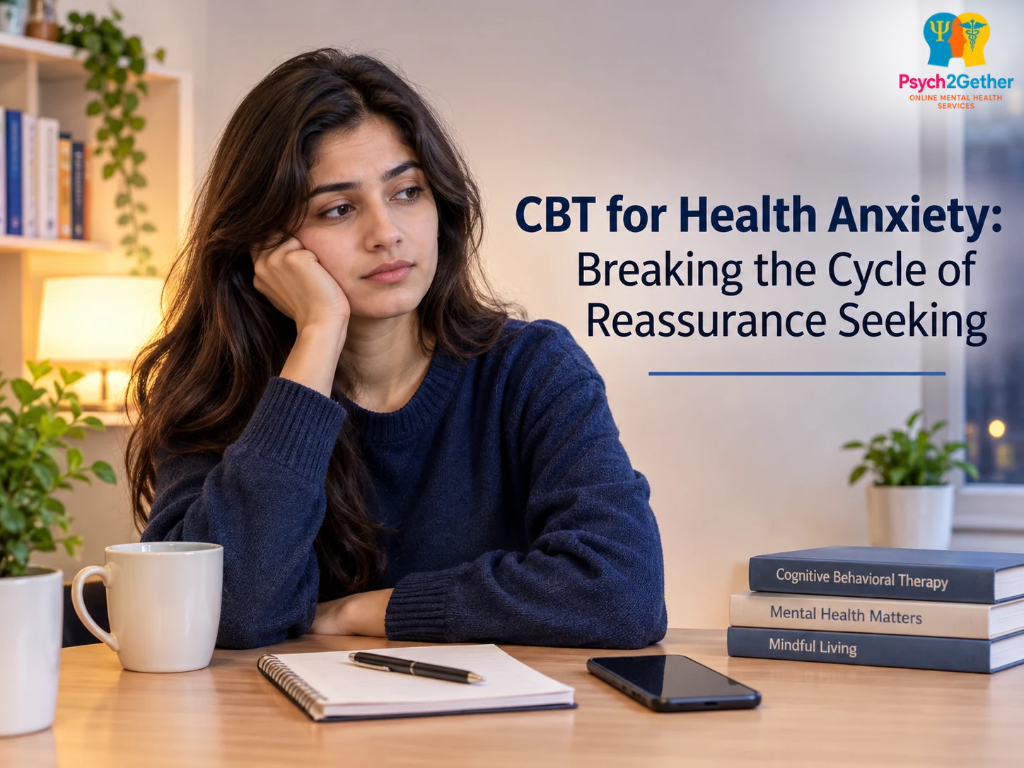
It’s 2 a.m., and you’re googling that odd twinge in your chest again. You feel calmer for a few minutes. Then the doubt comes back, louder than before. Sound familiar? CBT for health anxiety can help you get out of that loop. It doesn’t ask you to ignore your worries. It teaches you to sit with uncertainty, so you can stop chasing relief and start getting your life back. Let’s see how the cycle works and how to break it.
Why Health Anxiety Feeds on Reassurance
Here’s how it usually goes. You notice a small thing, like a headache or a fluttery heartbeat. Your mind jumps straight to the worst. Fear spikes, and you need an answer now.
So you ask your partner, book another scan, or search online. It works, for a while. Then the doubt creeps back. Your brain has now learned that checking equals safety, so next time the urge hits harder.
If that sounds a bit like OCD, you’re not imagining it. This guide to CBT for OCD explains a very similar loop of fear and relief.
How CBT for Health Anxiety Works
CBT is simple at heart. It looks at how your thoughts, feelings, and actions feed each other. And no, it won’t tell you your fears are silly. It helps you test them.
With a therapist, you’ll usually:
- Catch the thoughts that set off panic
- Question the worst-case stories your mind tells you
- Cut back on checking, one step at a time
- Get more comfortable with not knowing
Slowly, the fear loses its grip. You’ll notice that anxiety rises, peaks, and then drops by itself. You don’t need a quick fix every single time.
Reassurance Habits You Might Not Notice
Reassurance seeking can be sneaky. Plenty of these habits look completely reasonable, which is why they slip by.
See if any of these ring a bell:
- Googling the same symptom again and again
- Asking family if you look ill
- Booking repeat tests you don’t medically need
- Checking your pulse, skin, or lumps
- Dodging health news or hospital visits
Avoiding things counts too. It feels like protection, but it keeps the fear going.
All that questioning can wear on the people close to you as well. Our post on ADHD and relationships shows how repeated worries can quietly build distance.
Practical CBT for Health Anxiety Exercises
Try these small steps this week:
- Delay the check. Wait ten minutes, then twenty.
- Write the worry down instead of searching it.
- Tell yourself, this is anxiety talking.
- Ask loved ones for support, not reassurance.
- Plan something calming for when the urge hits.
It’ll feel slow at first. That’s normal. Each check you skip shows your brain you can cope with doubt.
When It’s Time to Get Some Help
Self-help only goes so far. CBT for health anxiety works best with a trained guide. At Psych2Gether, our clinicians offer CBT online. You can also read about finding a mental health therapist or a child psychologist for your little one.
Health worries often overlap with other struggles. Try these:
- Hormonal changes and ADHD
- Early autism signs in women
- How childhood trauma therapy works
- Psychotic depression symptoms
- Psychotic bipolar depression symptoms
Final Thoughts
Breaking free from reassurance seeking won’t happen overnight, and that’s okay. Your brain has practised this habit for a really long time. CBT for health anxiety gives you real tools to handle doubt without panic. Start small. Be patient with yourself. Every skipped check is a win. If you’d like caring, expert support, Psych2Gether offers online therapy with experienced clinicians and a free 15-minute consultation. You don’t have to carry this worry alone. Reach out to us today.y, it can feel like a weight lifting once somebody finally understands what you’ve been dealing with.
To seek help or professional expertise connect with us at Psych2gether
To understand more, visit us at psych2gether, Atterbury Lakes, Fairbourne Drive, Milton Keynes MK10 9RG