

Understanding psychotic depression symptoms
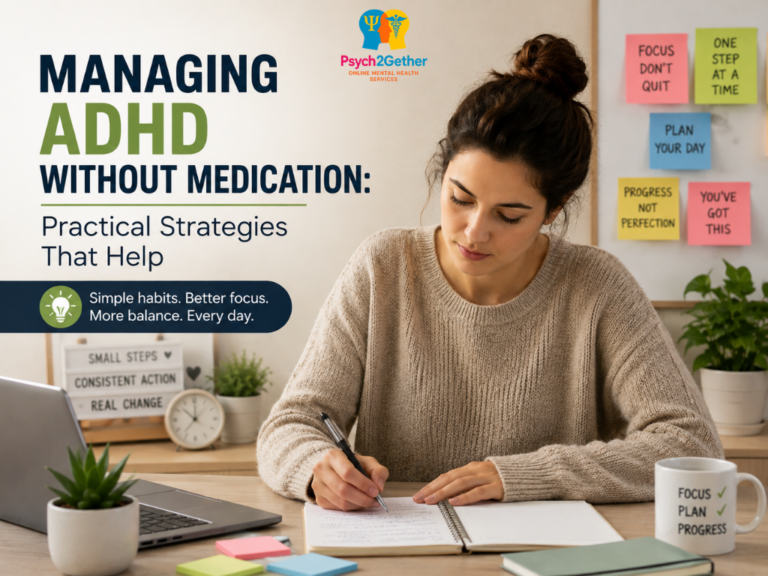
If you’re looking into managing ADHD without medication, you’re definitely not alone. Some people are wary of side effects, some want to try things naturally first, and others are already on medication but want more tools in the mix. Whatever the reason, the good news is that structure and small daily habits can genuinely take the edge off. This isn’t about “curing” ADHD – it’s about making everyday life a bit less exhausting.
Not everyone jumps straight to a prescription, and that’s okay. Some people just want to understand what’s going on in their head first. That’s usually where a proper ADHD assessment comes in – it gives you a clearer picture before you decide what treatment path actually fits, medication or not. At Psych2gether, we talk to a lot of adults who simply want answers before anything else.
Big life overhauls rarely stick. Small, boring, repeatable habits usually do.
None of this is groundbreaking, honestly – it’s just consistent. Our practical ADHD coping strategies guide goes into more detail if you want to build a fuller system.
Structure tends to do the heavy lifting that willpower can’t. ADHD brains generally do better with something external to lean on rather than trying to “just focus harder.”
Once these become automatic, you’re not spending energy deciding what to do next – that energy goes toward actually doing it.
Pushing through symptoms for months without support catches up with people. It’s more than just being tired. Our piece on understanding ADHD burnout walks through how it builds up quietly and what recovery actually looks like – not just “rest more.”
ADHD and anxiety show up together a lot. Racing thoughts and restlessness make focus even harder to hold onto. If that sounds familiar, an anxiety assessment can help separate what’s ADHD and what’s anxiety. Some people also notice physical symptoms – tight chest, stomach issues – which our article on health anxiety and physical symptoms covers in more depth.
Talking therapy isn’t just for crisis moments – it can help with focus, self-esteem, and regulating emotions long-term. If old experiences are still shaping how you cope now, trauma counselling might be worth exploring too. And if you’re not sure where to start at all, a comprehensive mental health assessment is usually the simplest first step.
Managing ADHD without medication isn’t a one-and-done fix – it’s more of an ongoing tweak-as-you-go process. Some weeks the systems work great, other weeks they fall apart completely, and that’s normal too. Our Adult ADHD page has more on assessment and support if you want expert input, and our full mental health services page covers everything else on offer.
There’s no perfect formula here. But managing ADHD without medication is genuinely doable with the right combination of structure, self-awareness, and support along the way. Start small, keep what works, drop what doesn’t, and reach out to Psych2gether if you’d rather not figure it out alone.
Book Your Free 15-Min Consultation
Start with a conversation. No commitment. No pressure. Just expert guidance on whether a full assessment is right for you. No GP referral needed.
To seek help or professional expertise connect with us at Psych2gether
To understand more, visit us at psych2gether, 79 College RdHarrow HA1 1BD, UK